
Grief in Greek Culture Through Cinema
Carmen Gherardi
Greek cinema has carved out a distinctive space for thinking about death and grief, one that refuses to flatten mourning into a single, tidy emotion. Rather than showing grief as either stoic silence or dramatic breakdown, contemporary Greek films sit with its nuances, letting it be personal and messy. The films featured in the Los Angeles Greek Film Festival portray how masculine ideas of grief and mourning have been prescribed onto Greek culture and how the modern Greek woman is taking on a more passionate and nuanced stance on how negative emotions are allowed to be felt. These films challenge the notion that there is a fixed “right” way to grieve.
For the majority of the 1900s, especially in more rural Greece, women were the one who took care of the dead and the mourning process. Most men were away working and making money for the family, therefore the woman’s domain was the home and family, which included dealing with any deaths in the family on their own. Women washed and dressed the dead, organized funeral rites, and performed lamentations which were poetic, communal, expressions of loss. Loring M. Danforth, in his book, The Death Rituals of Rural Greece, explains his first experience watching these lamentations and what a powerful experience it was. “One woman sat at the head of a grave, staring at a photograph of a young woman. She rocked gently back and forth, sobbing and crying. Suddenly, she began to sing a lament in a pained, almost angry voice. Before she finished the long melismatic line of the first verse she was joined by other women. The intensity of emotion in the women’s voices quickly increased,” (Danforth, 12). When women were the ones at the head of grieving it was allowed to be an emotional experience, you were allowed to show your feelings and be vulnerable with one another. There was no shame in asking for and accepting help and comfort from others. However, men were not as comfortable being confronted by negative feelings and being surrounded by so much unbridled emotion. For example, Danforth explains his experience watching men attempt to perform funeral practices of the time, “Eleni’s brothers, who had started to dig down through the gravel and sandy soil, were soon overcome with emotion, as the intensity of the lamenting increased. When they began to cry, two young women took their shovels and continued digging. Eleni’s brothers withdrew to the outside of the circle of women, where they stood quietly and awkwardly, men out of place in a woman’s world of death,” (Danforth, 19). The men cracked under all of the emotion and were unable to finish their job, passing the shovel back to the women. Women were once the culturally sanctioned voices of grief, yet over time, the dominant modes of grieving shifted toward something more masculine.
There was a shift toward stoicism as an emotional ideal in Greece which is a more masculine idea on how to deal with death and grief. Across Greek society, and especially among older generations, there developed a strong expectation that grief should be internalized rather than displayed, often channeled into religion or simply endured in silence, with a “life goes on” mentality. Persistent patriarchal structures underscore that there is a masculine dominance in both public and private life. How one mourns is no longer up to the individual, but up to the patriarchy. Since women were the ones mainly dealing with death and dealing with it outwardly and passionately, emotion in general became seen as a feminine trait, and under the patriarchy feminine means undesirable. In the chapter, “Genre and Gender: the case of soap opera” written by Christine Gledhill, in the book, Representation, she references the shift in Hollywood to accredit emotion as a feminine trait, “However, in the twentieth century, melodramatic forms, such as the so-called ‘women’s picture’ or ‘weepies’ which Hollywood produced in the 1930s, 1940s and 1950s, and the emotionally intense TV drama series and serials, such as soap opera, have become identified as feminine genres,” (Gledhill, 346). This idea of men wiping their hands clean of emotion, defining it as a female trait and adopting stoic ideals was a shift that obviously did not only happen in Hollywood, but in Greek society as well. However the differences between how men and women grieve were not the only reason for this change, urbanizations and the mass migration out of rural towns and into cities was also a big factor in separating Greek society from the old ways of mourning and dealing with death. In Gender and Power in Rural Greece, one of authors, Anna Caraveli, states that “A rising village middle class and those with urban jobs returning to the village for brief visits, frequently were embarrassed by lamenting relatives…In the villages where I worked the lament tradition was, with few exceptions, performed by middle-aged or old women” (Caravelli, 170). As the Greek population moved towards urban spaces and modernity, these public and open displays of emotion were looked down on as primitive, something from the old world that modernity no longer has the time or energy for. With the new fast-paced individualistic lifestyle that was spreading across Greece frowned upon these old traditions, and encouraged people to move on quickly, or at least make it look like they are.
This transition from the large displays of emotion to bottling up emotions could have also been a response to the emerging Greek stereotypes that were coming from America or other Western areas. There were more and more films emerging that focused on Greece, however they all stereotyped Greek people as a somewhat hedonistic primitive society. In one chapter from Hellenisms: Culture, Identity, and Ethnicity, from Antiquity to Modernity, by Katerina Zacharia, states how these films perpetrated the idea of Greek people as primitive, “From the primitivist stereotypes of Cacoyannis’s Zorba and the ethnographically empirical portrayal of the rural of his earlier film A Girl in Black (To Koritsime ta Màvra, 1956), it is an easy step to associate Greece in the 1990s with renewed imported images of Balkan primitivism. The third story in a series of vignettes in Pantelis Voulgaris’s It’s a Long Road (Ola Einai Dromos, 1998) focuses on a Greek merchant whose wife left him, taking their children with her. The heart-broken husband is shown drowning his pain in a dive, breaking not only plates, but practically everything breakable, including water basins and toilet bowls, and finally ordering a bulldozer to demolish the dive itself, while setting his own raincoat on fire and dancing away his sorrows. This performance of grief in the presence of Balkan prostitutes at the northernmost borders of Greece assimilates the Greek merchant to the immediate Balkan neighbors rather than their European counterparts, bypassing the cosmopolitan images Athenian intellectuals much rather favor in their own performance of culture.” (Zacharia, 336). It’s a Long Road portrays the grieving Greek man as overly-feeling and violent, destroying everything in his path in order to try and get over his loss, but nothing ever seems to be enough. To this man rules and logic no longer matter, only feelings, he is primitive. The adoption of stoicism and the avoidance of intensity, which spread throughout Greek society, eventually to mourning practices, was a reaction to the American stereotypes of Greek culture.
One of the Los Angeles Greek Film Festival films that did an amazing job at showcasing the older more masculine ways of grieving vs the feminine ways that are being re-embraced as of late is Don’t Laugh (They’ll See You) (2025, 1hr 25mins), Directed by Nicholas Dimitropoulos. This story is about a woman named Maria and her sister, Elena, who are both dealing with the loss of their mom. Even though they are from the same family and only a few years apart their ideals and overall way of life is very different, along with their ways of grieving. Maria is a very liberal and open minded individual, while Elena is extremely religious and lives her life by a strict set of morals. With the difference in grieving between the two sisters and eventual debate of whether Maria should get an abortion or not after figuring out she’s pregnant, the family becomes completely divided, eventually leading to the sisters not speaking at all. Elena grieves in a more masculine fashion, which was spread in the late 1900s and early 2000s. Elena takes on a more logical stance, stemming from men’s instincts to solve problems and have answers to all their questions, towards the end of the film, around 1 hour and 26 minutes when Maria and Elena are reconciling after Maria lets Elena’s daughter throw a party at her house. Elena gets more in depth about her husband, Elias’, death, claiming that it was the catalyst for her delving so deep in religion. Elena claims that her husband did everything right, he ate well, he didn’t smoke, he kept himself strong, but one day they randomly found a tumor in his body, which he ended up dying from. It all felt so random and so unfair, so she turned to God to try and make sense of it, to try and believe that there was some sort of greater purpose to it, that in God’s plan it was meant to happen. Elena refuses to embrace the randomness and absurdity of life and death, and she refuses to let herself feel as if she’s not in control, she masks her emotions with blind faith in religion. Control is a big part of modern masculinity and stoicism, within Representation, the chapter, “Exhibiting Masculinity”, by Sean Nixon, he claims “In addition, the codings of masculinity in these films privilege the attributes of toughness, hardness and being in control. These are codings which do not allow the display of ambiguities, uncertainties or weaknesses,” (Nixon, 315). The masculine idea of bottling up your emotions after a loss or turning to religion are all attempts to stay in control when something inherently out of your control has happened. While this film does a great job at portraying the masculine ideals around grieving that were prescribed onto greek women, it also shows the modern greek womans response to these conventions and how they’re taking back their freedom to express negative emotions as they want to. Femininity and the free expression of emotion has the ability to accept that losses and the emotions that come out of those losses are out of our control. Maria attempts to cope with the death of her mother and struggles with whether she should get an abortion or not in a myriad of ways, unafraid to express her feelings to others. She makes good friends with her neighbor using her community as a tool to help her grieve and process her loss and to talk through her dilemma with. In Greece back when women were in charge of death rituals, it was a very communal experience where women often leaned on each other and offered help in times of need. It’s very different from the more masculine ideal of dealing with hardships on your own and putting on a brave face in front of others. When she spends time with her neighbor she’s able to unload her feelings, she’s able to cry and get angry, which in turn helps lighten the load of emotions. Once the sisters finally talk about their emotions with each other it’s framed as a positive thing which causes the two to reconcile their relationship. In the end, around 1 hour and 32 minutes the two sisters, along with Elena’s daughter, visit the mothers grave. However, things feel very different in this scene compared to the conversations surrounding their mother previously. While they are obviously sad they both seem lighter, like a weight has been lifted off their chest from keeping their emotions from each other for long. The two sisters are able to look back on their time with their mother happily, and even crack jokes about the situation, laughing and expressing their feelings of joy rather than keeping up a stoic front as one would expect in a cemetery.
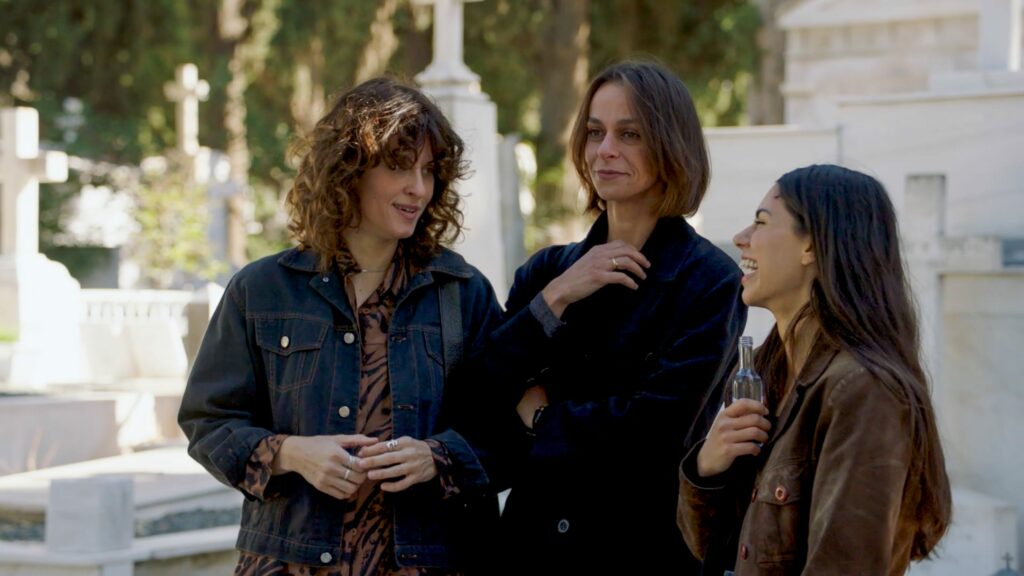
Dreaming of Lions, directed by Paolo Marinou-Blanco, was the standout film of the festival for me, and the one that stuck with me the most long after watching it. It is worth noting upfront that the film is not technically set in Greece, it takes place in Portugal with Portuguese actors, however the behaviors and attitudes around death and grief that it portrays map so closely onto Greek culture that it feels entirely at home in this conversation. The film centers on Gilda, who is terminally ill, and the people around her who each respond to her dying in completely different ways. Gilda herself refuses to be pitied, using humor and sarcasm as a shield, putting on a brave face rather than letting others see her fall apart. This connects to a broader pattern in Greek culture where grief and illness become something to endure privately, to save face rather than process openly. The film makes this literal through the image of a smiling mask, a symbol of people performing strength for others while quietly suffering underneath. The film’s most pointed critique, however, is directed outward: at a government that offers no real support to the sick and dying. This issue is raised in this Portuguese film, however there are similar issues happening in Greece. The way medicine in Greece has gone about taking care of the dying is also connected to the masculine ideal of bottling things up and sealing them away. In chapter, “In Greece, Lament for the Dead, Denial for the Dying.” of The Hastings Center Report, Souzy Dracopoulou and Spyros Doxiadis claim “In the context of the hospital the dying patient’s condition is further denied during the last days of his or her life. These patients are isolated in small rooms away from the public, other patients, friends, and relatives. The reason for this isolation is ‘social’, by distancing the terminal patient from others, the latter are protected from being negatively affected by his or her condition and eventual death,” (Dracoupoulou, Doxiadis, 16). Portugal and Greece have parallels in how the sick and dying are swept under the rug in order to maintain a strong looking exterior. Dreaming of Lions does a perfect job of showing how these sick and suicidal people are ignored by society at large and are not allowed to express their feelings outwardly, in fear of other people being affected by them. Because of these societal norms Gilda falls victim to the attitude of taking everything on by herself and keeping her brave face on, eventually dying alone without truly saying goodbye to her best friend.
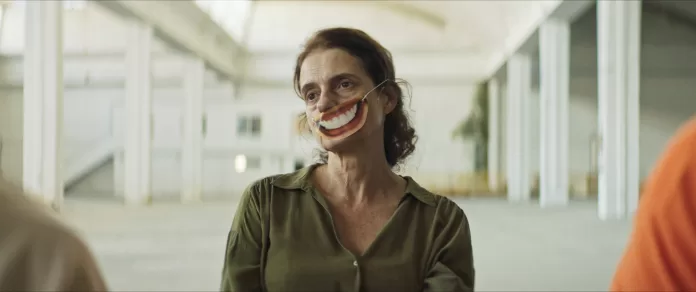
They Come Out of Margo (2025, 1hr 31mins), Directed by Alexander Voulgaris, was another one of the Los Angeles Greek Film Festival films that dealt with the subject of loss. Margo, the main character is dealing with the literal death of her sister, Margret, and the metaphorical death of her music career, as she shies away from the spotlight with plans to have a baby that never come to fruition. This film does an amazing job at showcasing the variety of emotions that one goes through when mourning, and doing so in a surreal disorganized way, which is representative of the true human brain. Throughout this film, which all takes place in a single day, Margo’s birthday, which is also near the time of her sister’s death, Margo and her party guests go through a rainbow of emotions, sadness, joy, fear, anxiety etc…Margo is unafraid of sharing her emotions communally, and her community of friends help her through every step of the way. There is even a connection to lamenting, which older rural based women used to do for the dead in Greece and is now seen as primitive in Greek society. There is a constant throughline of song and performance in this film, singing seems to be a way that Margo and other characters process their feelings and lighten their emotional load. They Come out of Margo also explores the trauma that is carried within a person when a significant loss happens in their life. While more masculine thought would prefer a person to bottle up their trauma and not speak about it to others, Margo confides in her friends, and they in turn help her through it. Ever since her sister went missing years ago, Margo thinks that she’s next, constantly fearing that people are coming to get her. She fears death every waking moment, and in turn she despises being alone, believing that once she’s left alone she will be murdered. While it may sound like paranoia, it’s not a farfetched feeling/fear to have after having a sister go missing. Towards the end of the party, when people are leaving, she begs people to stay, desperately trying to convince her best friend to stay with her so she doesn’t have to be alone. While it hurts the friend to see Margo in so much distress, she knows that Margo needs to get over this fear in order to live a happier life. The friend stays with her a few moments longer, and then leaves her house, for Margo to face her fears herself. In the end this helps Margo greatly, and she makes great strides forward in moving on from her sister’s death and her resulting trauma. However, if Margo wasn’t so expressive and vocal about her emotions, if she didn’t confide in the community around her, she wouldn’t have gotten the help and support she needed to get through this tough time.

Regan (2025, 1hr 24mins), directed by Panos Katsimperis, is perhaps the most direct in its critique of how older generations in Greek culture enforce emotional silence around death and grief. The film opens with a telling moment: an older woman is shamed by those around her simply for wearing red to her husband’s funeral, the implication being that even the color of your clothing in mourning is subject to judgment and control. This scene acts as a kind of thesis for everything that follows, the older generation’s insistence that grief be performed correctly, quietly, and without any visible disruption. Regan’s parents embody this, pressuring her to suppress her emotions rather than express them. But what the film suggests, powerfully, is that emotions don’t disappear just because you push them down, they will come back in other ways. Throughout the film Regan suffers a series of similar nightmares surrounding the topics of abortion, motherhood, and child-care. Regan’s nightmares are a direct result of that suppression, her subconscious refusing to stay quiet even when she attempts to push her feelings down in daily life. This idea connects to Charles Stewart’s chapter, “Dreams of Treasure: Temporality, Historicization, and the Unconscious” in the book, Hellenisms: Culture, Identity, and Ethnicity from Antiquity to Modernity, “Connection to a particular place, or to one’s own forebearers, provides alternative proximate causes for ruminating on the past. Widespread beliefs in haunted houses offer one ready example of how a local past can seize hold of one’s imagination, even if one is not related to the haunting spirits…My reading of such dreams of treasure dovetails with Durkheim’s explanation for the frequency of dreams of deceased ancestors: both are ruminations on the continuity of society” (Stewart, 284). Here Stewart suggests exactly what takes place in Regan, suggesting that what we refuse to process while awake finds its way into our sleeping minds regardless. While it is not completely cut and clear, through Reagan’s dreams the audience can assume she has suffered the loss of a child, a miscarriage. Through the film it is portrayed that the pressure to “quiet down” is really a pressure to conform to a dying set of values around what grief is allowed to look like.

The films featured at the Los Angeles Greek Film Festival make one thing clear: suppressing grief does not make it go away, it just changes the shape it takes. As this paper has argued, masculine ideals of stoicism and emotional restraint were prescribed onto Greek culture over time, slowly replacing the communal, expressive mourning traditions that women had led for generations, and the modern Greek woman is now pushing back against that. Maria reaches out to her neighbors. Margo fills her house with people and song. Even Regan’s nightmares refuse to stay quiet no matter how hard she tries to push her feelings down. As Caraveli observed, women were once the culturally sanctioned voices of grief in Greece, and these films are reclaiming that, insisting that feeling things openly and communally is not a weakness or a sign of being primitive. It is the most human response to loss there is.
Bibliography
- CARAVELI, ANNA. “The Bitter Wounding: The Lament as Social Protest in Rural Greece.” Gender and Power in Rural Greece, edited by JILL DUBISCH, Princeton University Press, 1986, pp. 169–94. JSTOR, https://doi.org/10.2307/j.ctvcmxs7q.13. Accessed 12 Apr. 2026.
- DANFORTH, LORING M., and ALEXANDER TSIARAS. “DEATH IN POTAMIA.” The Death Rituals of Rural Greece, Princeton University Press, 1982, pp. 9–24. JSTOR, https://doi.org/10.2307/j.ctv143mddd.5. Accessed 12 Apr. 2026.
- Dracopoulou, Souzy, and Spyros Doxiadis. “In Greece, Lament for the Dead, Denial for the Dying.” The Hastings Center Report, vol. 18, no. 4, 1988, pp. 15–16. JSTOR, https://doi.org/10.2307/3563249.
- Gledhill, Christine with Vicky Ball. “Genre and Gender: The Case of Soap Opera” Representation, 2013.
- Nixon, Sean. “Exhibiting Masculinity” Representation, 2013.
- Stewart, Charles. “Dreams of Treasure: Temporality, Historicization, and the Unconscious” Hellenisms: Culture, Identity, and Ethnicity from Antiquity to Modernity, 2010.
- Zacharia, Katerina. “‘Reel’ Hellenisms: Perceptions of Greece in Greek Cinema” Hellenisms: Culture, Identity, and Ethnicity from Antiquity to Modernity, 2010.